As supply chains grow more complex, customer expectations rise, and volumes of orders fluctuate wildly, inventory management is no longer about just counting stock and tracking location. In 2025, cloud-based Warehouse Management Systems (WMS) are becoming essential tools that deliver agility, real-time insights, scalability, and cost-savings. Companies like 3Gistix are stepping in to help businesses modernize their warehouse operations using cloud-based WMS solutions.
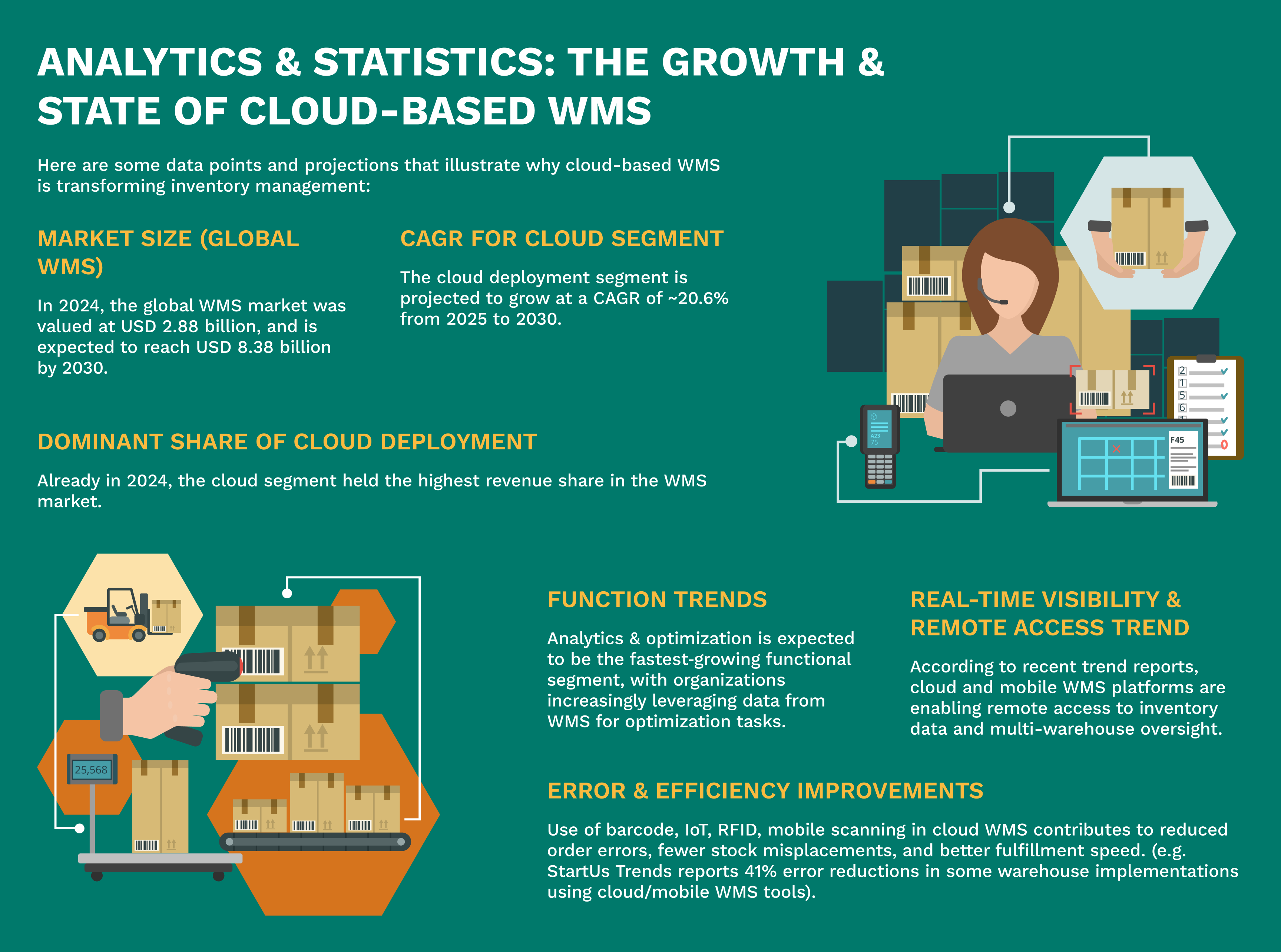

Key Benefits of Cloud-Based WMS in 2025 (with 3Gistix Context)
Here are the main benefits that businesses are seeing (or could expect) when using cloud-based WMS, especially solutions from firms like 3Gistix:

Scalability and Flexibility
Cloud-based WMS lets warehouses scale up or down easily depending on demand (peak seasons, promotions, demand surges). No need for heavy investment in servers or physical infrastructure. Firms like 3Gistix can help configure scalable cloud WMS so operations stay lean and responsive.

Real-Time Visibility & Remote Management
Because the WMS is cloud-hosted, stakeholders can track inventory levels, order status, shipments, and warehouse operations in real time, from anywhere. For companies running multiple warehouses, 3Gistix’s cloud-enabled dashboards allow unified oversight, helping avoid stockouts or overstock situations.

Lower Upfront Costs & Maintenance Overhead
Compared to on-premise WMS, cloud-based systems reduce hardware, server, and IT maintenance costs. Updates, patches, security enhancements are centrally managed. For SMBs especially, 3Gistix’s cloud offerings reduce barriers of entry.

Integrations & Automation
Cloud WMS often integrates easily with other systems: ERP, TMS (Transportation), e-commerce platforms, IoT sensors, barcode/RFID systems. 3Gistix can help tie these together so inventory flows, replenishment, picking/packing are more automated, reducing human errors.

Analytics, Optimization & Predictive Capabilities
With more data collected in real time, cloud WMS enables analytics: forecasting demand, optimizing placement of inventory, optimizing picking routes, reducing wasted motion, better labor allocation. 3Gistix can support analytics dashboards that help businesses make data-driven inventory decisions.

Speed of Deployment & Updates
Cloud solutions can often be deployed faster than on-premise ones. Also, enhancements, feature updates, and improvements are delivered continuously. 3Gistix is well-positioned to deliver cloud WMS solutions with regular improvements and user support.
Challenges & Considerations
While cloud-based WMS brings many benefits, businesses should also be mindful of:
Security & Data Privacy
Ensuring that data stored in cloud is secure, encrypted, with access control. Regulatory compliance (e.g. privacy laws) must be considered.
Connectivity & Reliability
Dependence on internet connectivity; offline capabilities or failover are important in areas with unstable networks.
Change Management & Training
Moving from manual or on-premise systems to a cloud WMS requires staff retraining and possibly reorganizing workflows.
Vendor / Partner Selection
Choosing a provider that offers good support, integration capability, and future growth is crucial. A partner like 3Gistix should be evaluated for track record, customization options, and customer support.
How 3Gistix Is Poised to Play a Role
Here are how I foresee 3Gistix helping businesses leverage cloud-based WMS in 2025:
- Offering cloud-native WMS platforms with modular functionality (you can start simple, then add analytics, automation, multi-warehouse support as needed).
- Enabling integration with IoT sensors, mobile devices, barcode/RFID, e-commerce APIs to ensure inventory is tracked accurately and in real time.
- Providing dashboards and predictive analytics tools so businesses can forecast demand, reduce overstock, improve order accuracy.
- Supporting remote management and mobile access, allowing operational oversight even for distributed warehouses or offsite fulfillment centers.
- Ensuring updates, security, redundancy, and disaster recovery are managed as part of the cloud service, reducing burden on clients.
Conclusion
In 2025, inventory management has to be more than reactive; businesses must operate with agility, accuracy, and insight. Cloud-based WMS are redefining the way warehouses are run: bringing real-time visibility, integrated automation, predictive analytics, lower costs, and scalability. The market data supports this shift clearly—high growth, increasing adoption, and the cloud segment leading the charge.
For businesses seeking to stay competitive, particularly in fast-moving sectors like retail, e-commerce, manufacturing, or 3PL, investing in a robust cloud WMS is no longer optional—it’s a competitive imperative. Partners like 3Gistix offer the tools, integrations, and support to make this transformation smoother and more effective.
If you haven’t already, now is the moment to evaluate your current warehouse systems. Ask: Can you see inventory in real time? Can you respond quickly to demand changes? Are your costs growing disproportionately with your scale? If the answer is “no” in any area, a cloud-based WMS, with the right partner, can be your path to operational excellence.
References
- Grand View Research. Warehouse Management System Market (2025 – 2030)
- StartUs Insights. Explore the 10 Latest Trends in Warehouse Management [2025]