In 2025, sustainability isn’t just a buzzword for businesses—it’s a competitive imperative. Third-party logistics (3PL) providers are increasingly being held accountable not only for delivering goods on time and at the lowest cost but also for minimizing environmental impact. One of the most significant trends shaping modern logistics is the integration of carbon accounting tools directly into 3PL services.
Carbon accounting tools help logistics providers measure, track, analyze, and report greenhouse gas emissions throughout the supply chain. As environmental regulations tighten and customers demand greater transparency, integrating these tools has become essential for forward-thinking 3PLs—including service partners like 3gistix—to meet evolving market expectations.
What Is Carbon Accounting in 3PL?
Carbon accounting refers to the process of calculating and reporting greenhouse gas emissions from business activities. For 3PLs, this means tracking emissions from transportation, warehousing, and related operations—in many cases across Scope 1 (direct emissions), Scope 2 (indirect energy emissions), and Scope 3 (supply chain emissions).
Given that supply chain emissions often make up the majority of a company’s carbon footprint, accurately measuring and reporting these figures improves sustainability performance and supports compliance with frameworks like the Greenhouse Gas (GHG) Protocol and emerging regulations.
The Rapid Growth of Carbon Accounting Tools in Logistics
The demand for carbon accounting solutions in logistics is rapidly increasing, driven by both regulation and customer expectations:
📊 Industry Adoption Trends
- Logistics providers and freight forwarders constitute about 60% of the market demand for carbon accounting software, signaling widespread integration across the sector.
- Third-party logistics (3PL) providers represent a major user segment, leveraging carbon accounting tools to differentiate service offerings and meet stringent sustainability reporting requirements.
- Research indicates that accurate carbon tracking is now a prerequisite for many large shippers when selecting a 3PL partner.
How 3PLs Are Integrating Carbon Accounting Tools
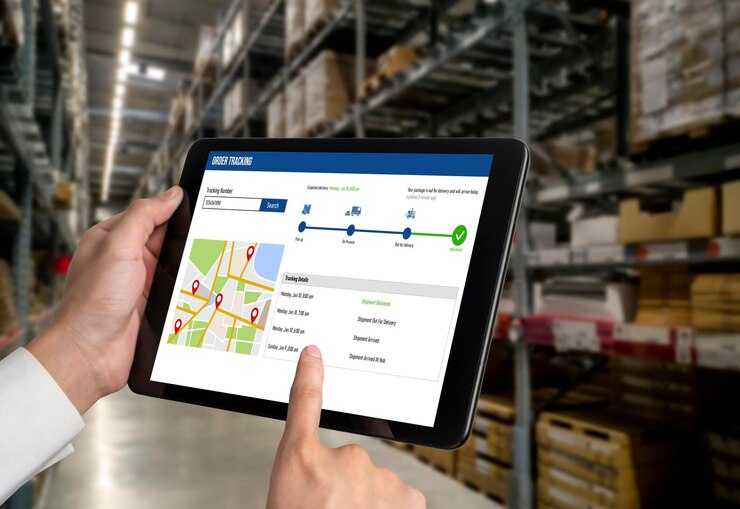
Embedded in Transportation Management Systems (TMS)
Modern carbon accounting platforms link directly with a 3PL’s TMS, automatically pulling data from carriers, routes, vehicle types, fuel consumption, and distances traveled to calculate emissions in real time. These integrations eliminate manual spreadsheets and provide clean, auditable data.

Connected to Enterprise Resource Planning (ERP) and WMS
By synchronizing with warehousing and enterprise systems, carbon tools can account for energy use in facilities, material handling, and even indirect emissions associated with inventory processing.

Supplier and Partner Data Integration
Advanced platforms map emissions across multi-tier supply chains (beyond direct operations), offering visibility into the footprint of suppliers, carriers, and subcontractors.
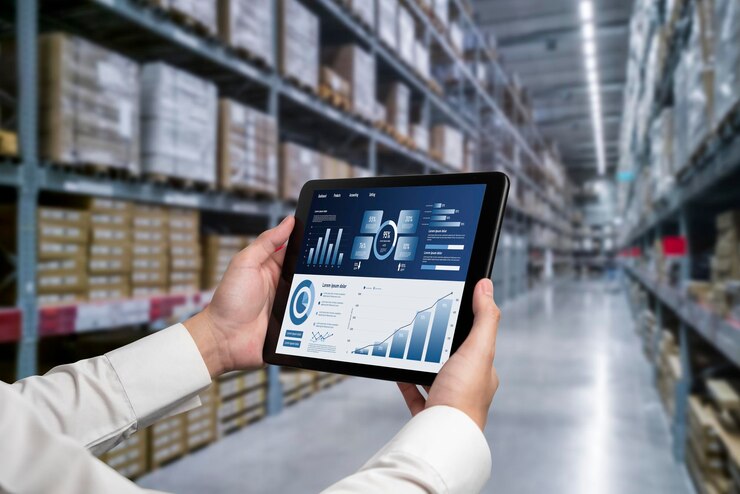
Automated Reporting and Compliance
Tools now automate the generation of sustainability reports aligned with global standards and frameworks, streamlining compliance with both local and international environmental reporting requirements.

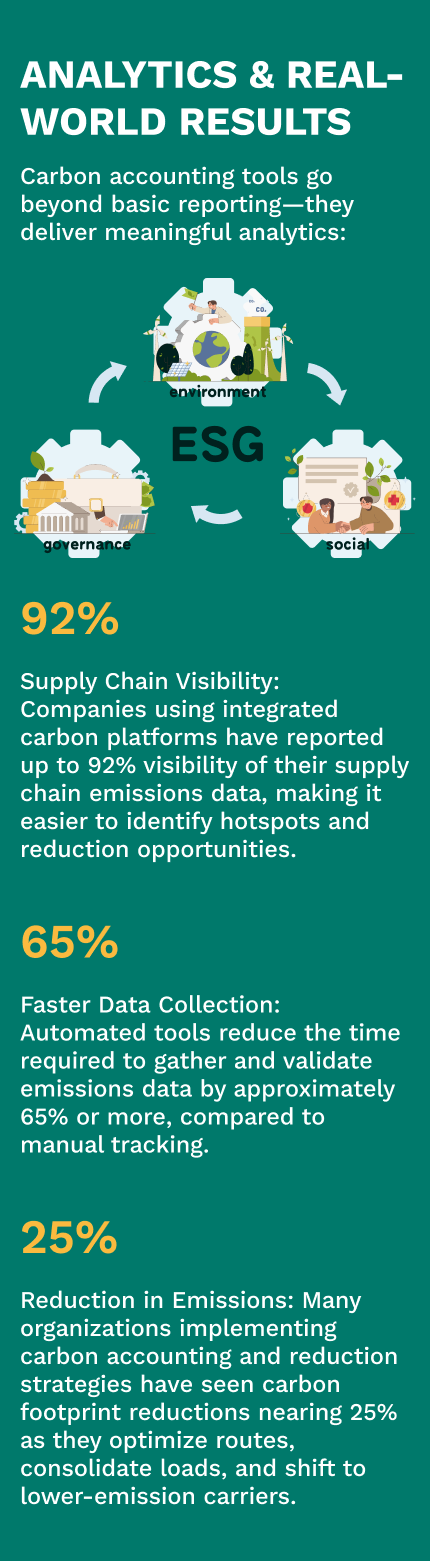
Key Benefits of Carbon Accounting Integration in 3PL Services
Enhanced Transparency
Clients today expect actionable, auditable information about the emissions associated with their logistics operations. Integrating carbon tools allows 3PLs to deliver transparent reporting and demonstrate environmental accountability.
Regulatory Compliance
As sustainability reporting frameworks evolve, embedded carbon accounting supports compliance with regulations like the EU’s Corporate Sustainability Reporting Directive (CSRD) and forthcoming climate disclosure rules.
Cost Optimization
Carbon data analytics help identify inefficiencies—such as excessive idling or suboptimal routes—leading to fuel savings and reduced operational costs.
Competitive Differentiation
3PLs that offer sustainability performance metrics and net-zero support position themselves as trusted partners, not just service providers, giving them an edge in bid processes.
Strategic Decision-Making
Advanced dashboards and metrics help 3PLs plan investments (e.g., electrified fleets or renewable energy facilities) and make data-driven decisions that align with long-term sustainability goals.
Challenges and Best Practices
Despite the progress, challenges remain:
🔹 Data Integration Complexity: Merging carbon data from disparate systems and partners requires careful planning and standardization.
🔹 Scope 3 Emissions: These indirect emissions are often the hardest to quantify, yet they represent the largest portion of a supply chain’s carbon footprint.
Best practices to overcome these challenges include:
- Leveraging APIs and real-time data feeds
- Benchmarking against industry standards
- Engaging partners in emissions tracking early
- Aligning carbon metrics with business KPIs
Conclusion
Carbon accounting tools have quickly evolved from niche sustainability software to essential components of modern 3PL services. By integrating these tools into core logistics systems—such as TMS, WMS, and ERP—3PL providers can unlock greater transparency, improve environmental performance, ensure compliance, and deliver enhanced value to their customers.
References
- CarbonAnalytics. Supply Chain
Carbon Tracking - Taxilla. Built for Decarbonization-Driven Procurement