In modern logistics, reacting to problems after they happen is no longer enough. Delays, stock imbalances, route disruptions, fuel volatility, and shifting customer demand all put pressure on supply chains to become faster and more precise. Predictive analytics helps solve this by using historical data, real-time inputs, statistical models, and machine learning to forecast likely outcomes before disruptions escalate. That gives logistics leaders a stronger basis for planning inventory, transport, warehousing, and fulfillment.
For companies looking to stay competitive, predictive analytics is becoming a practical decision-support capability rather than a future-facing experiment. In logistics operations, it can improve demand forecasting, identify supply risks earlier, optimize replenishment timing, and support more resilient planning across the network. For brands focused on scalable logistics transformation, 3Gistix can position this capability as part of a smarter, more data-driven supply chain strategy.
Key Benefits

Better demand forecasting
One of the clearest benefits of predictive analytics in logistics is more accurate demand planning. By analyzing historical order volumes, seasonality, promotions, customer behavior, and external signals, businesses can estimate future demand with greater confidence. This helps reduce both overstocking and stockouts while improving service consistency. IBM notes that AI-driven demand forecasting uses historical and real-time data to generate more actionable demand estimates, while SAP highlights how predictive capabilities reduce guesswork in procurement and purchasing.
For 3Gistix, this matters because better forecasting improves how inventory is positioned across warehouses, how transport capacity is allocated, and how fulfillment teams prepare for spikes in volume.

Stronger inventory control
Inventory is one of the costliest pressure points in the supply chain. Predictive analytics helps logistics teams determine where inventory should sit, how much safety stock is necessary, and when replenishment should occur based on likely demand and risk signals. This improves working capital efficiency while supporting order fill rates and customer expectations. IBM notes that AI inventory management supports accuracy, cost savings, and customer satisfaction, all of which are core logistics performance goals.
For 3Gistix, this can translate into leaner stock management, lower holding costs, and smarter warehouse utilization.

Improved transport and routing decisions
Predictive models can also improve transportation planning by anticipating delays, congestion, route inefficiencies, and shifting delivery patterns. When logistics teams can predict where bottlenecks may appear, they can reroute earlier, adjust dispatch timing, and coordinate more effectively across carriers and distribution points. SAP’s logistics and SCM materials emphasize the role of connected planning in improving the movement of goods across warehousing, fulfillment, and distribution.
This gives 3Gistix a strong SEO-relevant narrative: smarter logistics is not just about moving goods faster, but about making transport decisions with better foresight.
Greater resilience against disruption
Predictive analytics is especially valuable when supply chains face volatility. Weather events, port congestion, labor shortages, supplier issues, and demand swings can all affect logistics performance. Predictive tools help teams spot patterns early, model alternatives, and build contingency plans before service levels are affected. McKinsey’s recent work on digital twins and AI-enabled supply chain planning highlights how predictive capabilities can improve efficiency and resilience across forecasting, sourcing, and supply planning.
For 3Gistix, resilience becomes more than a talking point. It becomes a measurable operating advantage.
From descriptive to predictive decision-making
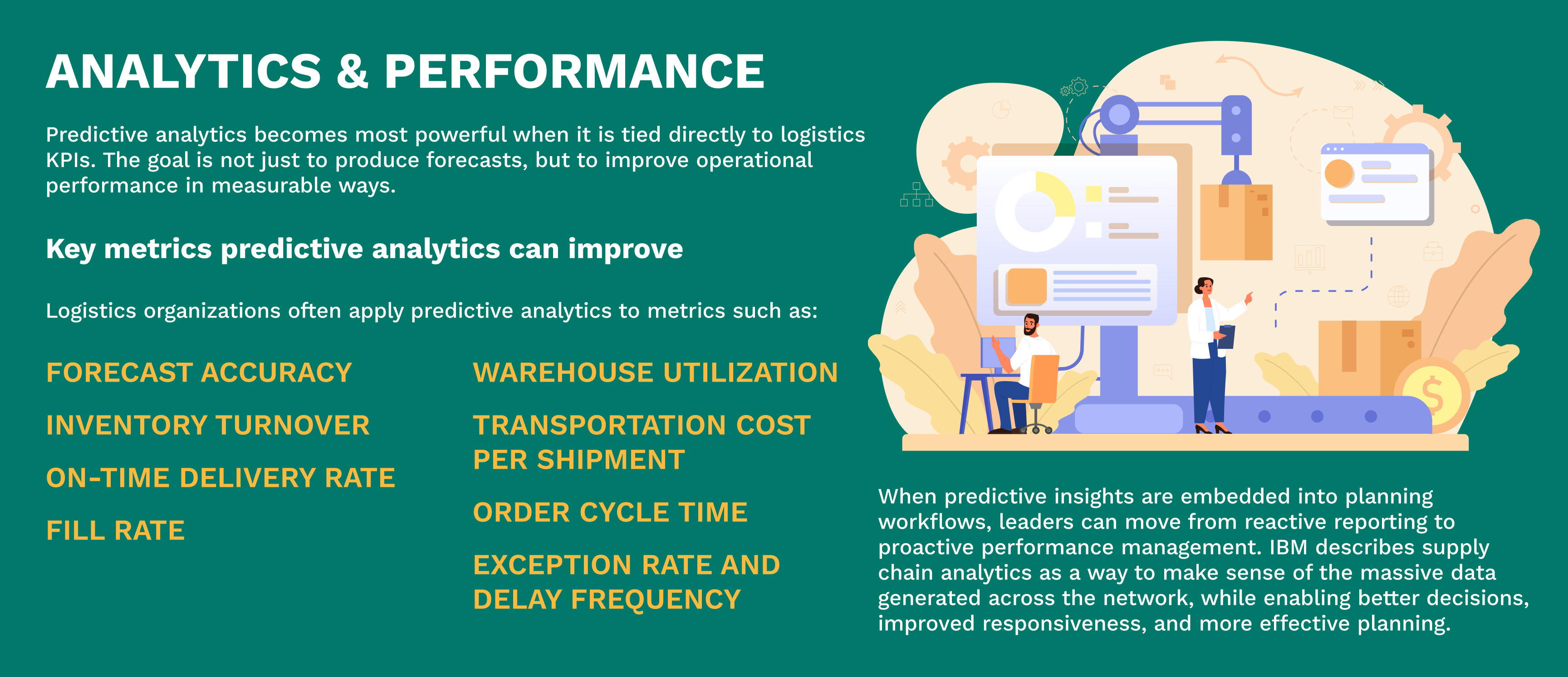
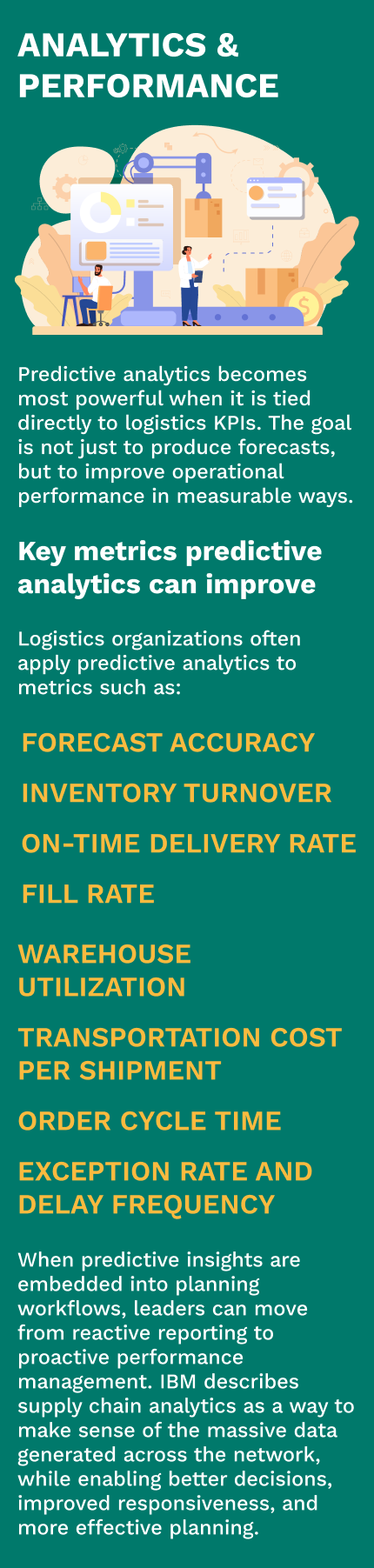
Traditional logistics reporting explains what happened. Predictive analytics goes further by estimating what is likely to happen next. That shift matters because supply chain teams rarely struggle from lack of data; they struggle from lack of timely, decision-ready insight. Predictive models can flag likely late shipments, identify where demand may exceed available stock, or estimate when asset performance could affect fulfillment flow. IBM defines predictive analytics as using historical data, statistical modeling, data mining, and machine learning to predict future outcomes, which is exactly why it has become so relevant to logistics planning.
For 3Gistix, this creates a compelling service message: logistics decisions become smarter when analytics is used not just to monitor performance, but to shape the next move.
Real business impact
The performance upside can be significant when predictive analytics is implemented well. McKinsey has reported that AI-enabled supply-chain management has helped early adopters improve logistics costs, inventory levels, and service levels versus slower-moving peers. While results vary by business maturity, data quality, and execution discipline, the direction is consistent: predictive capabilities can meaningfully improve both efficiency and responsiveness.
That makes predictive analytics an important strategic conversation for logistics providers and supply chain partners such as 3Gistix, especially when clients expect better visibility, reliability, and cost control.
Conclusion
Predictive analytics is reshaping logistics by helping companies make faster, more informed supply chain decisions. Instead of relying only on historical reports or manual judgment, businesses can use data models to anticipate demand, optimize inventory, improve transport planning, and reduce disruption risk. The result is a supply chain that is more efficient, resilient, and aligned with customer expectations.
For 3Gistix, incorporating predictive analytics into its logistics messaging strengthens its value proposition in a market where clients increasingly want visibility, agility, and measurable performance improvements. As supply chains become more complex, smarter forecasting and decision support will not be optional—they will be central to competitive logistics execution.
References