Global supply chains are becoming more distributed, more risk-aware, and more regionally structured. Instead of relying on a small number of far-flung nodes, many companies now want logistics networks that place inventory, fulfillment, and transport capacity closer to major demand centers. That shift is helping drive the rise of regional 3PL hubs—strategic logistics locations that support faster delivery, better resilience, and more flexible cross-border operations. DHL says regionalization remains a major supply-chain trend as companies move operations nearer to end customers and diversify supply bases across multiple countries, while McKinsey’s recent supply chain work points to ongoing network redesign in response to risk, tariffs, and shifting manufacturing footprints.
For logistics providers, regional hubs are no longer just warehouse locations. They are becoming control points for inventory positioning, multimodal transport access, customs efficiency, and service-level performance. For SEO purposes, 3Gistix can frame regional 3PL hubs as a smart response to today’s supply chain priorities: resilience, speed, visibility, and scalable market access.
Key Benefits
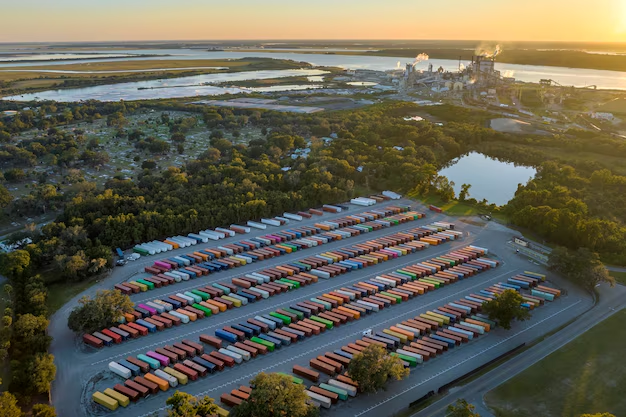
Faster access to key markets
One of the biggest advantages of regional 3PL hubs is proximity to customer demand. When inventory is stored and managed closer to end markets, businesses can reduce lead times, improve delivery performance, and respond more quickly to demand changes. This is especially important as customer expectations continue shifting toward shorter delivery windows and more reliable fulfillment. DHL’s trade and resilience coverage emphasizes that regionalization is accelerating as companies rebalance sourcing and distribution nearer to the customer.
For 3Gistix, this means regional hub strategy can be positioned as a way to help clients serve multiple countries or territories more efficiently without relying on a single distant distribution point.

Greater resilience against disruption
Regional 3PL hubs also strengthen resilience. A logistics network built around multiple strategic hubs is generally better able to absorb port congestion, geopolitical tension, tariff changes, weather events, and transport bottlenecks than a highly centralized model. McKinsey’s recent survey work highlights how companies are rethinking supply chain risk and manufacturing footprints, while Gartner-linked coverage identifies regionalization as a core capability for future-ready supply chains.
For 3Gistix, that creates a strong message for clients: regional hubs can reduce concentration risk and support business continuity when one corridor or market becomes unstable.

Better alignment with shifting trade patterns
The growth of regional 3PL hubs also reflects how trade flows are evolving. DHL’s 2025 trade materials show that global trade remains active even amid turbulence, and that regions such as ASEAN are becoming more prominent in cross-border trade flows. McKinsey also points to Southeast Asia as an increasingly important manufacturing and logistics zone.
This matters because logistics infrastructure should follow the geography of trade. For 3Gistix, regional hub strategy can be tied directly to where customers are sourcing, producing, and selling now—not where the network used to be.

More efficient cross-border and multi-country operations
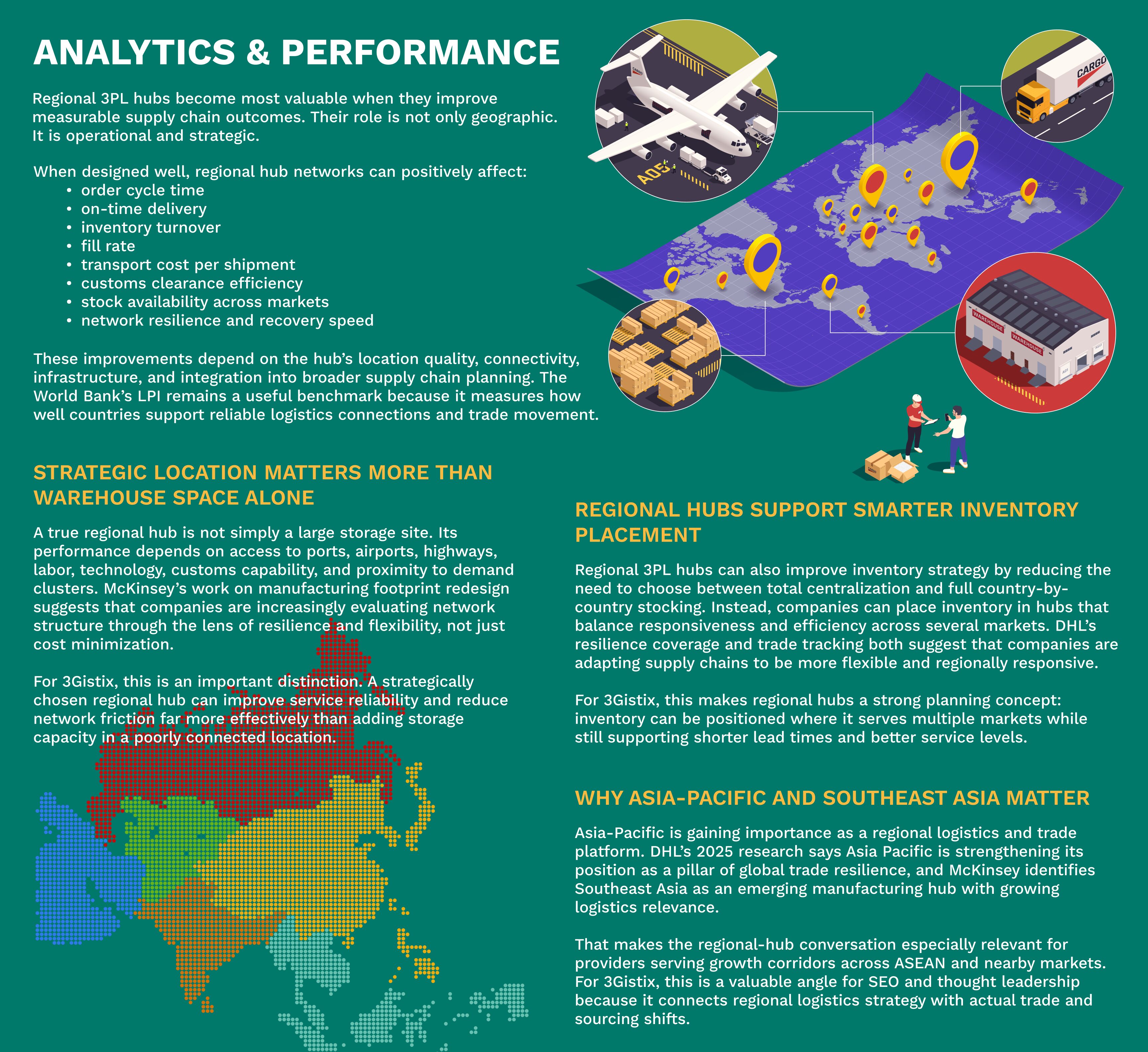
A well-placed regional 3PL hub can serve as a gateway for several nearby markets. That can simplify customs coordination, reduce duplicated inventory, improve transport planning, and support better control over replenishment across countries in the same region. The World Bank’s Logistics Performance Index continues to frame logistics capability around reliable supply chain connections, customs, infrastructure, and service quality—factors that all influence whether a location functions effectively as a regional hub.
For 3Gistix, this supports a practical value proposition: the right hub location can create both service and cost advantages across an entire region.

Conclusion
The rise of regional 3PL hubs reflects a larger transformation in global supply chains. Companies want networks that are faster, more resilient, and better aligned with today’s trade realities. Strategic regional hubs help make that possible by bringing inventory closer to customers, reducing disruption exposure, supporting multi-country distribution, and improving logistics performance across the network. DHL, McKinsey, Gartner-linked reporting, and the World Bank all point in the same general direction: regionalization, resilience, and stronger logistics capability are becoming central to supply chain design.
For 3Gistix, regional 3PL hubs are a powerful content theme because they speak directly to what modern shippers need: strategic locations, smarter inventory placement, and dependable access to global and regional markets.
References
- DHL – Rethinking Supply Chain Resilience in Turbulent Times
- DHL – Global Connectedness Tracker, 2025 Special Update
- DHL – Asia Pacific Emerges as a Pillar of Global Trade Resilience
- McKinsey – Diversifying Global Supply Chains: Opportunities in Southeast Asia
- McKinsey – Decoding Disruption to Reshape Manufacturing Footprints